I am a lost soul seeking apotheosis through serendipity. “The only difference between you and God is that you have forgotten you are divine.”― Dan Brown
BIG SUNSPOT: The source of the CME that hit Earth on Sept. 26th is sunspot AR1302. Measuring more than 150,000 km from end to end, the sprawling active region is visible even without a solar telescope. Here it is among the seagulls at sunset on Sept. 27th:
Damien Vens took the picture from the beach in Koksijde, Belgium. "I used an off-the-shelf Nikon D7000 digital camera," he says. "The sunspot was an easy target." (Note to photographers: Never look at the sun through unfiltered optics such as camera viewfinders; even a low-hanging sun can be blindingly bright.)
AR1302 has quieted down since unleashing dual X-flares on Sept. 22nd and 24th. Nevertheless, NOAA forecasters estimate a 25% chance of more X-flares during the next 24 hours. Any such eruptions would be Earth-directed as the sunspot crosses the center of the solar disk.
“We in Otsu-City, Shiga Prefecture, 311 miles (500 km) from Fukushima, are seeing readings around 0.15 microsieverts on average, which is around five times what the Japanese government is reporting. My wife and children will leave Japan as early as possible because I perceive a growing exodus will come and it might become hard to place kids in schools.””
- Frank Daulton, Ph.D., Applied Linguistics, Ryukoku Univ., Kyoto, Japan
Fukushima Prefecture (top red circle) is where TEPCO nuclear power plants exploded and melted down after the March 11, 2011, 9.1 magnitude earthquake and tsunami. Fukushima, is 500 kilometers (311 miles) from Kyoto and Shiga Prefectures (lower red circle), where ground radiation in September 2011 is five times higher than what the Japanese government says, according to university professor.
September 30, 2011 Otsu-City, Shiga Prefecture, not far from Kyoto, Japan - Fukushima Prefecture (top red circle) where TEPCO nuclear power plants exploded and melted down after the March 11, 2011, magnitude 9.1 earthquake and giant tsunami east of Sendai. The distance from Fukushima southwest to Kyoto and Shiga Prefectures (lower red circle) is 500 kilometers (311 miles). Even with the 500-kilometer-distance from Fukushima, one concerned university professor in September 2011 near Kyoto is measuring ground radiation where he lives in Otsu-City, Shiga Prefecture, at around .4 microsieverts/hour. That is at least ten times higher than the 0.03 microsieverts/hour background level the Japanese government asserts. That misinformation, the professor says, is because the Japanese government is afraid to tell the truth.
September 29, 2011
“Japan ‘scared’ of telling truth to Fukushima evacuees
A former adviser to the Japanese cabinet has revealed the government has known for months that thousands of evacuees from around the Fukushima nuclear plant will not be able to return to their homes.
Nearly seven months after the meltdowns at Fukushima, about 80,000 people are still living in shelters or temporary housing.
Former special adviser to Japan's prime minister and cabinet Kenichi Matsumoto has told the ABC that the government has known for months that many who live close to the Fukushima plant will not be able to return to their homes for 10 to 20 years because of contamination.
... prime minister Kan actually said that Tokyo and eastern Japan might not be able to keep functioning; that it might collapse.”
Three weeks before Australia's ABC News reported that former special adviser to Japan's prime minister and cabinet, Kenichi Matsumoto, really knows the radiation situation in Fukushima and beyond is much worse than the government has admitted, Earthfiles received the following email from Frank E. Daulton, Ph.D., Prof. of Economics and Applied Linguistics at Ryukoku University, Kyoto, Japan, who commutes 20 kilometers from his home in Otsu-City, Shiga Prefecture.
From: Frank E. Daulton Subject: Radiation Cover-up in Japan Date: September 8, 2011 To: Linda Moulton Howe <earthfiles@earthfiles.com>
Dear Linda,
I need to report on the cover-up involving nuclear contamination throughout Japan. I have been conducting measurements and experiments near my home in Western Japan, more than 500 kilometers from Fukushima (in Shiga Prefecture). I have found the local soil to be quite and undeniably contaminated. Even ambient radiation levels are around five times government data.
However, there is no acknowledgement from the government or media of this situation. The average citizen has no idea of the dangers, and therefore, takes no precautions.
The only way to understand how the government can present false data showing absolutely no effect of Fukushima in Western Japan -- knowing that some day the lie will become apparent -- is that things are far worse than anyone has imagined. Indeed in Japan, one does not tell someone with cancer than he/she has cancer; it may 'upset' them too much. I think, in the future, we will be given a similar excuse for the current cover-up.
I am writing a paper on the situation and my measures to alleviate the radiation on my property. I have four small children, who I plan to send abroad early next year. They will be among the first of many 'radiation refugees'.
As an American Missouri journalism student, I had experience as a science/environment reporter. And my brother, with whom I consult, is a research physicist at Washington University in St. Louis. My data is good. I'm happy to share (or discuss) it with you.
Best regards,
Frank E. Daulton (PhD) Professor, Ryukoku University (Kyoto)
The next day on September 9, 2011, the Wall Street Journal headlined: Japan Misstated Radiation.
Reporter Mitsuru Obe summarized a Japan Atomic Energy Agency report that week: “The Japanese government initially underestimated radiation releases from the Fukushima Daiichi nuclear plant, in part because of untimely rain, and so exposed people unnecessarily.”
That night Prof. Daulton talked with me on the record about the radiation measurements he was making with a professional Geiger counter on the inside and outside of his home and in the playground of his children's school. He is so concerned that his measurements are consistently higher than what the Japanese government has reported that he no longer trusts any official assurances about the air, water, land or food safety. Prof. Daulton is now preparing to evacuate his wife and four children to either Australia or the United States and knows he and his family are in the beginning of what he expects to be an increasing phenomenon of Japanese radiation refugees.
Prof. Frank Daulton and his family L to R: Ty age 7; Noelle age 11; Mrs. Etsuyo Daulton holding Yura age 1; and Hanna age 9, at their Otsu-City, Shiga Prefecture home in Japan on September 10, 2011.
Interview taped September 9, 2011:
Play MP3 interview.
Frank E. Daulton, Ph.D., Prof. of Economics and Linguistics, Ryukoku University, Kyoto, Japan: “As soon as anyone turned on an actual Geiger counter - if you are close to the ground level so that you are capturing not just the gamma radiation coming from all around you, but the beta particles that stop within a few meters from their contact with air molecules - if you are down at ground level, the measurements are around 0.4 microsieverts/hour. That is about 10 times higher than 0.03 microsieverts/hour background level asserted by official sources.”
Above: Prof. Frank Daulton holding Inspector Alert Nuclear Radiation Monitor close to ground around his home in Otsu-City, Shiga Prefecture, not far from Kyoto and 311 miles (500 km) from Fukushima. The measurement is 0.377 microsieverts/hour. Below: Another measurement of 0.341 microsieverts/hour near plants in Prof. Daultons's yard. Images taken in September 2011 by Frank Daulton.
Wikipedia explains the sievert (Sv) and microsieverts (μSv) in the International System of Units (SI) as a derived unit of dose equivalent radiation. It attempts to quantitatively evaluate the biological effects of ionizing radiation that are characterized by absorbed dose (of gamma and beta radiation).
SI Multiples and Conversions:
1 Millisievert = 0.001 Sv
1 Microsievert (1 μSv) = 0.000001 Sv
An older unit for the equivalent dose, is the rem, still often used in the United States.
1 Sievert = 100 rem
1 Microsievert = 100 millirem = 0.1 rem
1 rem = 0.01 Sv = 10 mSv
1 mrem = 0.01 mSv = 10 μSv
Prof. Daulton: “I also have to point out that official measurements are taken from atop tall buildings, which are usually government facilities. In the case of my Shiga prefecture, the (measurement height) is 20 meters (66 feet); in Osaka it is around 30 meters (98 feet).
[ Editor's Note:Wikipedia - The prefectures of Japan are the country's 47 subnational jurisdictions. Like states in the United States, prefectures are governmental bodies larger than cities, towns, and villages. The chief executive of each prefecture is a directly elected governor. Ordinances and budgets are enacted by a single-chamber assembly whose elected members serve four-year terms. ]
But the glaring problem is: although gamma radiation is very penetrating and can travel great distances and heights, beta particles - which is the other thing that radioactive iodine and cesium emit - are stopped within a few meters (by air molecules). So, the official data from the start is only reporting gamma radiation, which is only part of the total radiation that tends to be accumulating at ground level.
IT'S VERY CLEAR THAT HUMANS, ANIMALS AND CHILDREN WOULD BE CLOSE TO THE GROUND AND NOT AT 60 FEET UP IN THE AIR.
Yes, on my property we recently have done about $15,000 in work outside my house putting in driveways and changing our garden dirt with new dirt. But it was, and remains to be, quite radioactive at 0.4 microsieverts/hour.
Japan Chooses Denial
“The only way I can understand how the government could be under-reporting blatantly the data today is that in the future, they are going to rationalize it by saying, ‘We did not feel it was in the country's best interests to know right away.”
And other parents - this is maybe a very unique cultural thing in Japan - other parents would really not want to hear about this now.
DO YOU MEAN THAT THE JAPANESE WOULD PREFER DENIAL THAN FACE THAT THE RADIATION IS GOING TO PERSIST AT HIGHER LEVELS THAT CAN BE DANGEROUS FROM HERE INTO THE FUTURE?
I'm afraid so. An analogy is that at hospitals, if someone is diagnosed with cancer, often the patient is not told of the diagnosis - only the family members. The reasoning is that knowing the truth would trouble the individual too much. We are keeping the truth away from them for their own sake. So on the one hand, citizens themselves don't want to deal with this problem. It's overwhelming. Living in fear is not a step people want to take. Meanwhile, the government for the same reasons has a justification not to tell the public everything. In the end, the only way I can understand how the government could be under-reporting blatantly the data today is that in the future, they are going to rationalize it by saying, ‘We did not feel it was in the country's best interests to know right away. It would create economic chaos and a lot of trouble throughout Japan.’
It will become common knowledge that the contamination has come far beyond what is being reported in the media. Even yesterday, there was a story in the news saying that Japan will begin expanding its radiation monitoring to as far away as 450 kilometers (280 miles) southwest of Fukushima in Nagoya City (Aichi Prefecture). But remarkably in this news story, the monitoring will be done from the air by aircraft and not on the ground. It gives the appearance of the government moving forward. I'm fairly certain that the Japanese government knows quite a lot about this situation.
YOU ARE DESCRIBING A POLICY OF DENIAL TO KEEP A KIND OF PEACE OF MIND WHILE THE RADIATION IS GOING TO BE DOING DAMAGE AT ALL KINDS OF LEVELS.
Yes. The Prime Minister himself in an interview following his leaving office spoke about how he had been worried that Tokyo would receive a lethal dose of radiation and that it would be impossible to evacuate the 30 million people who live there. That for him had been a nightmare scenario. In the interview, one is left with the impression that,‘Yes, we dodged a bullet.’
In reality, though, it's not quite so black and white and none of Japan has escaped the after effects of this nuclear disaster and it is being felt in Tokyo enough so that Tokyo- and the Tokyo area - does receive mention in the media. Hot spots of contamination, especially where water drains off of concrete and in unfinished playgrounds - grass and dirt areas.
Above: Beachside park playground swings near Prof. Daulton's home in Otsu-City, Shiga Prefecture, not far from Kyoto, Japan. Below: Measurement of 0.341 microsieverts/hour near ground below swing that is 500 km/311 miles from Fukushima. Images taken in September 2011 by Frank Daulton.
Radioactive Food
“... already in Okinawa, for example, people are noting that food from the Fukushima area is in supermarkets. ... in the future it will be virtually impossible to avoid contaminated food if one is living in Japan.”
Okinawa residents (lower right circle) report that Fukushima Prefecture (upper right circle) food products are in Okinawa supermarkets. The Japanese Prime Minister was concerned that Tokyo (middle right circle) and eastern Japan “might collapse” as radiation has spread. Prof. Daulton in Shiga Prefecture reports that “Singapore authorities stopped food from Kobe in Hyogo Prefecture (far left circle near Shiga Prefecture circle) in far western Japan, about 650 kilometers away from Fukushima, because it exceeded the radiation limit.
Speaking with a friend of mine from the Tokyo area, I was speaking about the research and measurements I've been doing here and what I've heard. She was surprised, but not so surprised because in Tokyo they are aware that there are big problems. More and more of the problems will be the food supply. But she said something quite astounding - that although most Tokyo residents understand the situation more or less, they don't speak about it. There is almost a taboo of talking about this, which is very remarkable.
And after living in Japan for 23 years, still it was hard for me to imagine what cultural attribute would account for that. I think in the end that by mentioning it to other people, they are afraid of troubling the other person and of troubling themselves. Again there is this urge to deny. But with Japan being a single country with a single food distribution system, the big problem is going to be food itself. One aspect of that is that already in Okinawa, for example, people are noting that food from the Fukushima area is in supermarkets.
GROWN ON FARMS IN THAT REGION IS STILL BEING DISTRIBUTED THROUGHOUT JAPAN?
Absolutely! One of the first warning signs that I saw in the media early in the year was that Singapore authorities had stopped food from Kobe in Hyogo Prefecture in far western Japan, about 650 kilometers away (from Fukushima) because it exceeded the radiation limit. But even in the news story, no one questioned why that could be - that some place as far away as Hyogo Prefecture in far western Honshu main island, that in the future it will be virtually impossible to avoid contaminated food if one is living in Japan.
Rice flour that is used in ingredients in rice crackers, its origin will never be listed. So, it's very simple to conceal the origin of food. But in reality, food throughout Japan will be contaminated more or less wherever it is grown. However much radiation has come to the land in Japan, much more has gone into the ocean and will be carried both by currents and the large fish like the salmon that travel all across the world.
In my family, we don't eat fish anymore. My wife is Japanese. My children have grown up as Japanese. For Japanese people to stop eating fish is a huge adjustment. Just as 9/11 changed everything - especially in the United States - 3/11 that happened ten years later - 3/11 has changed everything in Japan. And I'm just afraid this has dealt a near-fatal blow to Japan. Japan will never be the same.
Japan Radiation Refugees
YOU WROTE IN YOUR EMAIL,‘I HAVE FOUR SMALL CHILDREN, WHO I PLAN TO SEND ABROAD EARLY NEXT YEAR. THEY WILL BE AMONG THE FIRSTOF MANY RADIATION REFUGEES.’
At this point, I'm urging my wife to make our plans as early as possible because I foresee at some point there will be a large scale exodus at which point it might become hard to place kids in schools. For the moment, it's not happening because most people are in denial.
WHERE WOULD YOU SEND YOUR CHILDREN?
Well, my main worry is that I will probably have to continue working in Japan to provide for my family. So where they are sent to will have to be someplace where I know people and will be a safe environment. And at this point all things considered, Australia where I know someone seems to be the likeliest candidate.
DO YOU FEEL THAT SOME TIME SOON THERE WILL BE AN INCREASING NUMBER OF RADIATION REFUGEES TRYING TO GET OUT OF JAPAN?
Yes, already the exodus of people began immediately, but within Japan from Fukushima. In the local news, there was a story about a family from Fukushima - husband, wife and child - who had moved to my area (Shiga Prefecture) to escape from the radiation. That's the first step in this process, which I think will begin in a larger scale. First from the areas immediately affected and families moving as far away as possible from Fukushima. But, as awareness and release of information increases, you will see people who have the ability economically to send their children abroad. They will begin to do so and it will be just a few people at first. But largely people go on with life because it is difficult to re-locate to a foreign country. The average Japanese person does not speak English or any other language. There might be no other alternative but to keep the whole family in Japan sort of in that gas-mask-type scenario in worst cases, but definitely avoiding certain foods.
I know many foreign faculty that have quit this year and are going back to their countries. But this practice might even come to the attention of the general public. There might be some news story about this phenomenon of people sending their kids abroad. And there might be some tipping point where more and more families do that.
In a really tragic sense, Japan has lost its future. I can't believe this is going on! This is a nightmare that you think you can just wake up from. Everything changed for me that afternoon when the house started shaking, and I don't know about the future anymore.”
June 6, 2011 Earthfiles Update: Japan's NERH Admits Fukushima Nuclear Units 1, 2 and 3 “Experienced Full Meltdowns.”
Deceiving the public and media, TEPCO never admitted the three meltdowns, but kept insisting it was cooling fuel rods at the core.
Japan's Nuclear Emergency Response Headquarters (NERH) announced on June 6, 2011, that the Fukushima nuclear power plant Unit 1 melted almost completely in the first 16 hours after the March 11, 2011, earthquake and tsunami and is now leaking radioactive water. The “major part” of Unit 2 fuel rods melted and fell to the bottom of that pressure vessel 101 hours after the earthquake. Unit 3 fuel rods also melted and fell to the bottom of the pressure vessel within 60 hours.
Einstein released many theories during his scientific career, but it was the publishing of his two theories of relativity that literally shook the foundations of physics. The theories proposed by him still stand today even though there are many individuals who have tried to challenge them. It started in 1905 with the publishing of his special theory of relativity and was later followed by the general theory of relativity in 1915 . Each of these theories are comprised of their own sets of equations, laws and principles that explain why things act the way that they do, from the largest of galaxies right now to the smallest of particles.
Einstein was in his mid-20's when he published his special theory of relativity which become an absolutely essential tool for scientists, physicists, theorists and experimentalists around the world today. Some of the concepts that were introduced were time dilation, length contraction, and his famed theory of mass-energy equivalence with the introduction of E = mc2. One of his other concepts, and the subject of this blog entry, was Einstein's introduction of the cosmic speed limit which states that no physical object or information can travel faster than the speed of light in a vacuum.
Shortly after the publishing of his special theory of relativity, he immediately began working out equations that encompassed geometric views of gravitation and introduced new and exciting concepts that replaced Newtonian mechanics, which had lasted 250 years. Scientists had been able to calculate low energy effects of gravity for centuries with Newton's theory, but until Einstein, what actually caused it had remained a mystery. Einstein's general theory showed the world that gravity was caused by the bending of space and time. So in short, it's not a gravitational force that is holding us all firmly down to the ground but it's space that is actually pushing you down. The theory explained such phenomenon as the bending of light by gravity and opened up the entirely new field of cosmology. The theory also made entirely new predictions, such as the Big Bang theory and also black holes, which continue to be a rich source of research for scientists.
Needless to say, Einstein's theory has with stood the test of time for almost a century and if there's one data-point out of place, we would have to throw the entire theory out. So everywhere we look into the heavens, Einstein's theory of general relativity comes right on the spot.
Last week, an international team of researchers and scientists reported that they have recorded sub-atomic particles appearing to travel faster than the speed of light. Over a period of three years, neutrinos were shot from the particle accelerator at CERN in Switzerland to a detector in Italy (the OPERA - Oscillation Project with Emulsion Tracking Apparatus) about 500 miles away. What the team found interesting was that the neutrinos arrived around 60 nanoseconds quicker than the light would have traveled. This recent result from the accelerator at CERN, which seems to contradict Einstein's theory of relativity, has generated enormous interest, among scientists as well as the public. However, not much has been written about precisely what this means for relativity itself.
Special Relativity of 1905, as discussed above, is based on the idea that the speed of light is the same, no matter who measures it, as long as you move smoothly and do not accelerate. This violates Newton's common sense notion that there is nothing special about the speed of light. Hence, something has got to give. So, our common sense notion of the universe must change if light speed is the same no matter how we measure it, whether it is coming toward us, away from us, or sideways. What gives is space-time. Hence:
Time gets slower in a rocket ship as it goes faster.
You get heavier as you approach light speed.
You get squeezed the faster you move.
All of the effects above have been observed. For example, our GPS satellites slow down a bit as they whiz overhead, just as Einstein predicted. There is also cosmic waves and particle accelerators that are also used to verify this fact.
If you get heavier the faster you move, then the energy of motion has turned into mass. The precise amount of kinetic energy that turns into mass is easily calculated using relativity (the derivation is 1 line long) and that result is the most celebrated equation in science, E = mc2.
So why is light speed the maximum speed in the universe? As you approach the speed of light, bizarre things begin to happen such as:
Time Stops
You are Infinitely Heavy
You are Infinitely Thin
If you exceed the speed of light, then you get nonsense such as:
Time Might go Backwards
You are Heavier than the Universe
You have Negative Width
For these reasons, Einstein stated that you cannot go faster than the speed of light. This also affects general relativity, which is the foundation of cosmology, since (for small distances) general relativity reduces down to special relativity. Hence, both are wrong if the recent CERN experiments are correct. Not only is cosmology, nuclear physics, atomic physics, laser physics, etc. all in doubt, but also the fundamental theories of particle physics are also thrown in doubt. The Standard Model of particle physics (containing quarks, electrons, neutrinos, etc). is also based on relativity and would also mean that string theory, my field, may also be wrong. String theory has relativity built-in from the start and the lowest octave of string contains the entire general theory of relativity.
So you can see why physicists are breaking out in a cold sweat contemplating the demise of relativity. Not only will all textbooks have to rewritten but we will also have to recalibrate all our physics calculations, not to mention all of our theories of both nuclear, atomic physics and cosmology. What a headache! So, I think most physicists are holding their breath, wishing that the recent CERN experiment is shown to be flawed and something of a false alarm. However, there is the slim chance that the result holds up. Then relativity may fall and we will have to await the coming of the next Einstein who can make sense out of it all -- In retrospect however, This is How Science is Done.
On September 25, Nik Cubrilovic posted a terrific analysis looking at how Facebook uses cookies to track users even when they have signed out of the service. His findings about Facebook cookie tracking raises yet more red flags about subscriber privacy. We asked and he granted permission to repost the analysis, which differs in two subtle ways from the original: Slight editing for house style and incorporation of two updates into the main text. We also changed the headline.
Dave Winer wrote a timely piece yesterday morning about how Facebook is scaring him since the new API allows applications to post status items to your Facebook timeline without a user's intervention. It is an extension of Facebook Instant and they call it frictionless sharing. The privacy concern here is that because you no longer have to explicitly opt-in to share an item, you may accidentally share a page or an event that you did not intend others to see.
The advice is to log out of Facebook. But logging out of Facebook only de-authorizes your browser from the web application, a number of cookies (including your account number) are still sent along to all requests to facebook.com.
Even if you are logged out, Facebook still knows and can track every page you visit.
The only solution is to delete every Facebook cookie in your browser, or to use a separate browser for Facebook interactions.
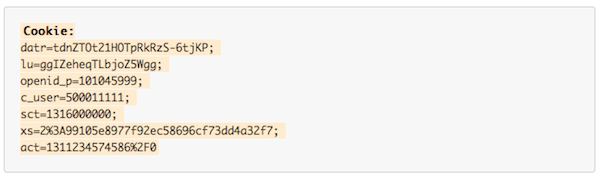
Here is what is happening, as viewed by the HTTP headers on requests to facebook.com. First, a normal request to the web interface as a logged-in user sends the following cookies:
Note: I have both fudged the values of each cookie and added line wraps for legibility.
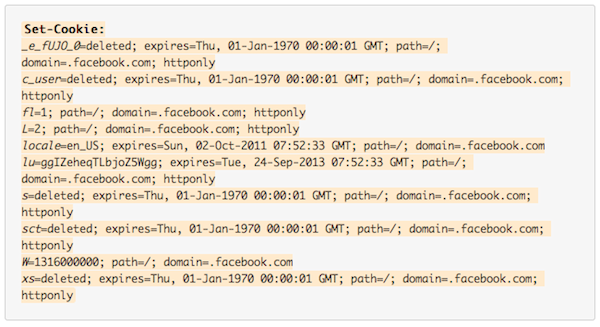
The request to the logout function will then see this response from the server, which is attempting to unset the following cookies:
To make it easier to see the cookies being unset, the names are in italics. If you compare the cookies that have been set in a logged-in request, and compare them to the cookies that are being unset in the log-out request, you will quickly see that there are a number of cookies that are not being deleted, and there are two cookies (locale and lu) that are only being given new expiry dates, and three new cookies (W, fl, L) being set.
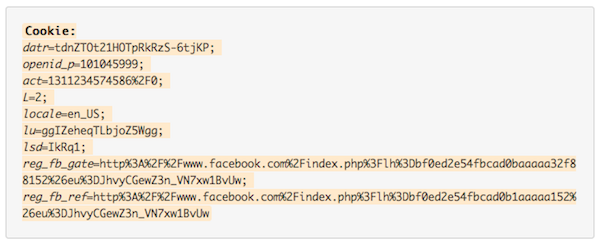
Now I make a subsequent request to facebook.com as a 'logged out' user:
The primary cookies that identify me as a user are still there (act is my account number), even though I am looking at a logged-out page. Logged-out requests still send nine different cookies, including the most important cookies that identify you as a user
This is not what 'logout' is supposed to mean. Facebook are only altering the state of the cookies instead of removing all of them when a user logs out.
With my browser logged out of Facebook, whenever I visit any page with a Facebook Like button, or Share button, or any other widget, the information, including my account ID, is still being sent to Facebook. The only solution to Facebook not knowing who you are is to delete all Facebook cookies.
You can test this for yourself using any browser with developer tools installed. It is all hidden in plain sight.
If you wish to view the raw logs, I have saved them here. Specifically the datr and lu cookies are retained after logout and on subsequent requests, and the a_user cookie, which contains your userid, is only cleared once the session is restarted. Most importantly, connection state is retained through these HTTP connections. There is never a clean break between a logged in session and a logged out session.
An Experiment
This brings me back to a story that I have yet to tell. A year ago I was screwing around with multiple Facebook accounts as part of some development work. I created a number of fake Facebook accounts after logging out of my browser. After using the fake accounts for some time, I found that they were suggesting my real account to me as a friend. Somehow Facebook knew that we were all coming from the same browser, even though I had logged out.
There are serious implications if you are using Facebook from a public terminal. If you login on a public terminal and then hit 'logout', you are still leaving behind fingerprints of having been logged in. As far as I can tell, these fingerprints remain (in the form of cookies) until somebody explicitly deletes all the Facebook cookies for that browser. Associating an account ID with a real name is easy -- as the same ID is used to identify your profile.
Facebook knows every account that has accessed Facebook from every browser and is using that information to suggest friends to you. The strength of the 'same machine' value in the algorithm that works out friends to suggest may be low, but it still happens. This is also easy to test and verify.
I reported this issue to Facebook in a detailed email and got the bounce around. I emailed somebody I knew at the company and forwarded the request to them. I never got a response. The entire process was so flaky and frustrating that I haven't bothered sending them two XSS holes that I have also found in the past year. They really need to get their shit together on reporting privacy issues; I am sure they take security issues a lot more seriously.
To clarify, I first emailed this issue to Facebook on the 14th of November 2010. I also copied the email to their press address to get an official response on it. I never got any response. I sent another email to Facebook, press and copied it to somebody I know at Facebook on the 12th of January 2011. Again, I got no response. I have copies of all the emails, the subject lines were very clear in terms of the importance of this issue.
I have been sitting on this for almost a year now. The renewed discussion about Facebook and privacy this weekend prompted me to write this post.
The Rise of Privacy Awareness
Ten to 15 years ago when I first got into the security industry the awareness of security issues amongst users, developers and systems administrators was low. Microsoft Windows and Internet Information Server were swiss cheese in terms of security vulnerabilities. You could manually send malformed payloads to IIS 4.0 and have it crash with a stack or heap overflow, which would usually lead to a remote vulnerability.
A decade ago, the entire software industry went through a reformation on awareness of security principles in administration and development. Microsoft re-trained all of their developers on buffer overflows, string formatting bugs, off-by-one bugs etc. and audited their entire code base. A number of high-profile security incidents raised awareness, and today vendors have proper security procedures, from reporting new bugs to hotfixes and secure programming principles (this wasn't just a Microsoft issue, but I had the most experience with them).
Privacy today feels like what security did 10-15 years ago. There is an awareness of the issues steadily building, and blog posts from prominent technologists is helping to steamroll public consciousness. The risks around privacy today are just as serious as security leaks were then -- except that there is an order of magnitude more users online and a lot more private data being shared on the web.
Facebook are front-and-center in the new privacy debate just as Microsoft were with security issues a decade ago. The question is what it will take for Facebook to address privacy issues and to give their users the tools required to manage their privacy and to implement clear policies - not pages and pages of confusing legal documentation, and 'logout' not really meaning 'logout'.
Erratum: I refer to the wrong cookie name in the post above. I also say 'all sites' can be tracked, when I meant to say 'all sites that integrate facebook'.
Nik Cubrilovic is an Australian-born serial entrepreneur, writer and hacker. He currently is working on pre-launch startups, previously at Techcrunch, Omnidrive and a number of other startups since 2000. He has lived in Australia, Bosnia, the UK, South Africa and the USA; Cubrilovic is currently based in Wollongong, Australia.
Rachael Rettner, MyHealthNewsDaily Staff Writer 26 September 2011 Time: 05:05 PM ET
Drinking coffee may lower women's risk of depression, a new study says.
Women in the study who drank two to three cups of caffeinated coffee a day were 15 percent less likely to develop depression over a 10-year period compared to those who drank one cup of coffee or less per week.
The researchers cautioned, however, that the new study only shows an association between coffee consumption and depression risk, and cannot prove that drinking coffee reduces risk of depression in women.
The study, which included more than 50,000 women in the United States, is the largest of its kind, the researchers, from the Harvard School of Public Health in Boston, said.
The findings are in line with earlier studies that have found a link between moderate coffee consumption and a reduced risk of suicide.
"Taken together, these results reassure coffee drinkers that there seem to exist no glaringly deleterious health consequences to coffee consumption," Dr. Seth Berkowitz, wrote in an editor's note accompanying the new study.
Because the study only shows a correlation between coffee and the risk of depression, it's too soon for doctors to recommend coffee consumption to patients, Berkowitz said.
The study is published in the Sept. 26 issue of Archives of Internal Medicine.
Caffeine and depression
The majority of adults in the United States consume caffeine, and coffee accounts for about 80 percent of daily caffeine consumption, the researchers said. But caffeine's effect on depression is not well understood, they said.
The researchers analyzed surveys of 50,739 U.S. women (average age 63) enrolled in a long-term study known as the Nurses' Health Study. From 1980 through 2004, participants filled out questionnaires about their caffeine consumption, including how often they drank coffee, tea and soda.
Participants were followed from 1996 to 2006 to see whether they were diagnosed with depression. None of the participants had depression at the study's start. Women were considered depressed if they had been given a diagnosis of clinical depression by their physician and they started taking antidepressants.
Over the 10-year period, 2,607 new cases of depression were reported. Women who drank four or more cups of coffee per day were 20 percent less likely to develop depression than those who drank one or fewer cups of coffee per week.
No link was found between consumption of decaffeinated coffee and depression.
Some individuals who consume caffeine experience sleep disturbances, insomnia or anxiety. It's possible that women with a history of depression, or women who are predisposed to depression, know about these side effects and reduce their caffeine consumption, the researchers said.
Caution urged
Emma Robertson-Blackmore, assistant professor of psychiatry at the University of Rochester Medical Center, calls the findings "interesting," but urged caution regarding the link.
For one, the women included in the study were nurses and their caffeine consumption may not be reflective of the U.S. women population in general, Robertson-Blackmore said.
The study also did not take into account factors known to trigger depressive episodes, including a past history of depression, financial difficulties and experiencing the death of someone close.
"Given how old the women were at the end of the study, you have to feel that most would be experiencing some of these changes," Robertson-Blackmore said.
Caffeine can make people feel more energized, focused and put them in a better mood in general. "This feeling could be reflected in the women’s assessment of their mood symptoms," Robertson-Blackmore said.
There are more robust predictors of depression other than how much caffeine you consume, Robertson-Blackmore said.
"Women should aim for a healthy balance in diet, stress reduction and exercise and be mindful of depression symptoms that require help from health professionals," she said.
Pass it on: Drinking two or more cups of coffee a day is associated with a reduced risk of depression in women.
TOKYO, Sept 28 (Reuters) - Japan faces the prospect of removing and disposing 29 million cubic metres of soil contaminated by the world's worst nuclear crisis in 25 years from an area nearly the size of Tokyo, the environment ministry said in the first official estimate of the scope and size of the cleanup.
Six months after the March 11 earthquake and tsunami triggered reactor meltdowns, explosions and radiation leaks at Fukushima Daiichi nuclear power plant on Japan's northeast coast, the size of the task of cleaning up is only now becoming clear.
Contaminated zones where radiation levels need to be brought down could top 2,400 square km (930 square miles), sprawling over Fukushima and four nearby prefectures, the ministry said in a report released on Tuesday.
Tokyo Metropolitan prefecture has a total area of 2,170 square kilometers (840 square miles).
The environment ministry has requested an additional 450 billion yen in a third extra budget for the year to next March that the government aims to submit to parliament in October, Kyodo news agency reported.
The government has so far raised 220 billion yen ($2.9 billion) to be used for decontamination work, but some experts say the cleanup bill cost reach trillions of yen .
If a 5 cm (2-inch) layer of surface soil, likely to contain cesium, is scraped off affected areas, grass and fallen leaves are removed from forests, and dirt and leaves are removed from gutters, it would amount to nearly 29 million cubic metres of radioactive waste, the document showed.
This would be is enough to fill 23 baseball stadiums with a capacity of 55,000 spectators, and the government must decide where to temporarily store such waste and how to dispose of it permanently.
Japan has banned people from entering within a 20 km (12 mile) radius of the plant, located about 240 km (150 miles) northeast of Tokyo and owned by Tokyo Electric Power Co . Some 80,000 people were forced to evacuate.
The government aims to halve radiation over two years in places contaminated by the crisis, relying on both the natural drop in radiation as time passes and by human efforts.
The ministry's estimate assumes that cleanup efforts should be mainly in areas where people could be exposed to radiation of 5 millisieverts (mSv) or more annually, excluding exposure from natural sources.
The unit sievert quantifies the amount of radiation absorbed by human tissues and a mSv is one-thousandth of a sievert. Radiation exposure from natural sources in a year is about 2.4 mSv on average, the U.N. atomic watchdog said. ($1 = 76.655 Japanese yen) (Editing by Ed Lane)